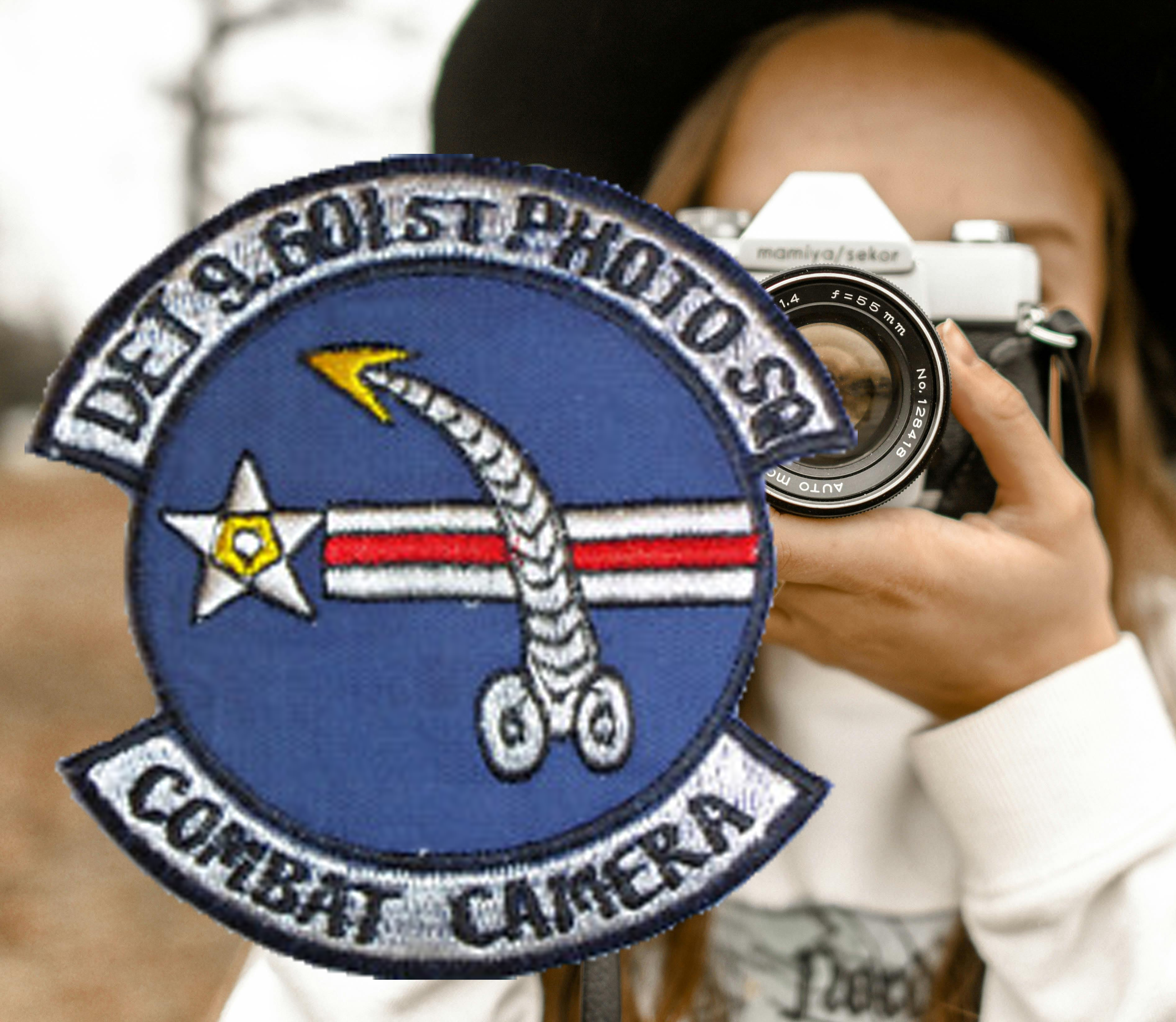
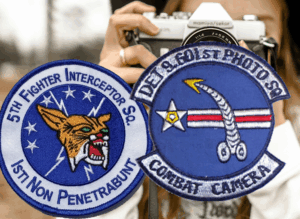
 How does one get started in a general practice of photo imaging? In Mr. Cardone’s case, his start was with the United States Air Force as an Aerospace Camera Repairman during the Vietnam Conflict. In that day, the Air Force had two divisions of photography: 1. Ground Cameras (AFSC 404xx); and 2. Aerospace (AFSC 402xx). But within the Aerospace division there were two subdivisons: 1. Reconnaissance; and 2. Combat Camera.
When Mr. Cardone enlisted in the Air Force in 1969, Air Force aptitude testing showed that Mr. Cardone had an aptitude for electronics.  Upon completion of his basic military training at Lackland Air Force Base, Airman Cardone was assigned to attend the Air Force seven-month Aerospace Camera Training school at Lowery AFB, Colorado. At that training school, students learn details of both reconnaissance and combat cameras (still and motion picture) used at that time by Air Force combat jets.
Upon completion of his camera training school, Airman Second Class (that’s a one striper, 40230), received orders to report to the Air Force 5th Fighter Interceptor Squadron at Minot AFB, North Dakota. The 5th Fighter Interceptor Squadron consisted of F-106 Delta Dart jets. Each of these were fitted with a radar recording camera which Airman Cardone was responsible for the maintenance of these but his duties were mainly to upload new unexposed film to each aircraft before a mission, then download and process that film upon mission completion and give it to strike intel. During that tour, Airman Cardone sewed on a second stripe for Airman 1st.
But also during his time at Minot, Airman Cardone had a lot of time on his hands. Minot, North Dakota is a desolate place and Airman Cardone had no car for personal  transportation. During his entire stay at Minot (winter of 69/70) he never left the base. But because he had so much time on his hands and an intense interest in electronics, he bought a subscription to the mail order National Radio Institute to learn intense electronics. Often, Wes completed two or even three workbooks (with labs) in a week. This material was directly aligned with what Wes had learned in the Air Force Basic Electronics school, except much more in depth.
Airman 1st Cardone then received orders to report to the 601st Photo Squadron Det. 9 at Udorn Royal Thai Air Force Base. The 601st Photo was a sub-division of the Air Force 600th Photo. The 601st had detachments throughout Southeast Asia. Det. 9 was one of those detachments. Here, operations were exclusively that of the Phantom, F-4G fighter.
At Det. 9, Sgt Cardone’s duties were a little different than they had been with the 5th FIS. He had advanced in his skill set becoming a 40250 and buck Seargeant. Here he was primarily responsible for the maintenance of the various camera systems and only on occasion went to the flightline to upload and download film. He was also tasked with special assignments such as fitting individual aircraft with special configuration gun camera systems for special assignments strike intel had defined. There were also special operations in support of other Southeast Asia 601st detachments. The 601st had a Lear jet shuttle it used to travel between the different SEA detachments. Sgt. Cardone caught a hop on that shuttle to travel to the Da Nang detachment in 1971 for a special one-month assignment. 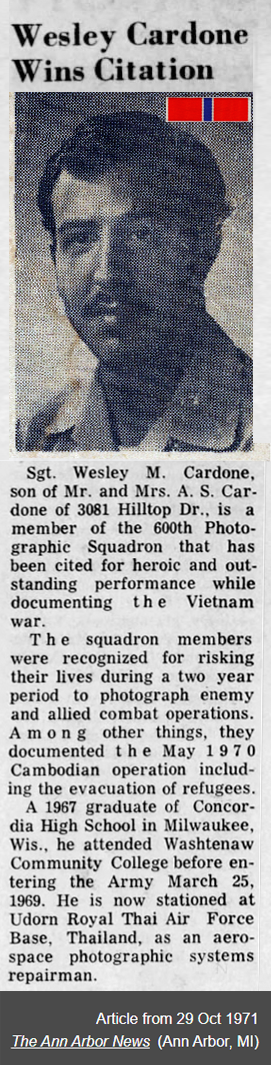
While it has no relation to Wesley’s start in photo imaging, at a little after midnight upon arriving at Da Nang, the base was hit by a 122mm rocket attack.
It was during Wes’ assignment at the 601st that its parent (the 600th Photo Squadron) was awarded the Bronze Star. Wes didn’t do anything directly regarding the special operations. He was merely a member of the organization that the medal was awarded to. But his mother was surprised to see the Ann Arbor News release on the decoration and was thrilled with the phone calls she was receiving from friends and relatives.
Sgt. Cardone’s assignment at Det. 9 was two years. But although he arrived as an Airman 1st.  He left with a line number for Staff Sergeant (SSgt). This was clearly because of what SSgt. Cardone had learned from his National Radio Institute curriculum. He was able to score very high on his Air Force testing resulting in an early rank advancement.
ADDENDUM
After leaving the Air Force in 1973, Mr. Cardone attended Solano Community College in Fairfield, California. His objective was to become an Electrical Engineer. But at the same time, Wes realized that he did not have the academic background to be accepted to an engineering school. Thus, at Solano Community College Wes studied bone-head everything. Bone-head Algebra, Bone-head Geometry, Bone-head Chemistry, bone-head everything and none of it for college credit. He worked nights at a 7-11 convenience market in Fairfield. to pay his way.
Click here if interested in a story about Wes being robbed at the 7-11 store.
Wes then applied for and received admission to the prestigious California Polytechnic State University in San Luis Obispo, graduating in 1980 with a BSEE (Bachelor of Science Electrical Engineering). Wesley even made the Dean’s List at Cal Poly.

Leave a Reply